


Government ‘holding house’ for Section 106 homes could keep delivery going, L&Q executive says
A senior L&Q executive has suggested the government considers setting up a “holding house” for Section 106 homes until registered providers are able to buy the properties.


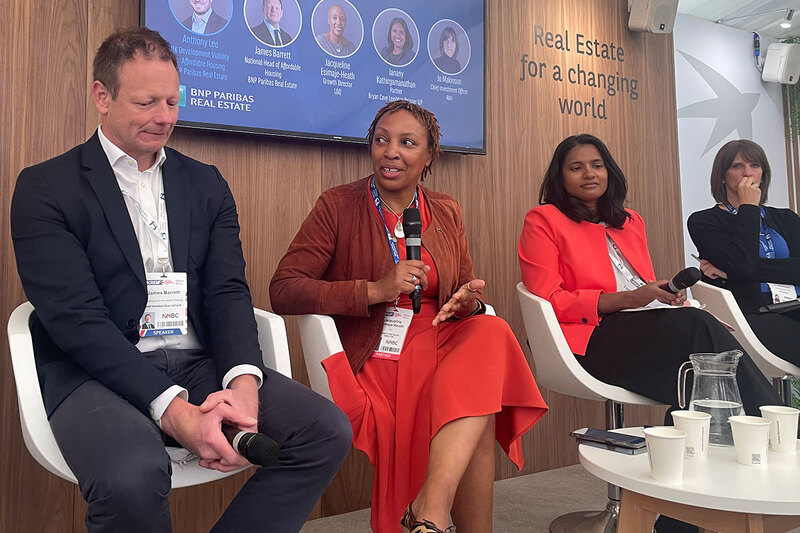
Left to right: James Barrett, Jacqueline Esimaje-Heath, Janany Kathirgamanathan and Jo Makinson
Sharelines
A senior L&Q executive has suggested the government considers setting up a “holding house” for Section 106 homes until registered providers are able to buy the properties #UKhousing #SocialHousingFinanceJacqueline Esimaje-Heath, growth director at the 109,000-home landlord, said there is “clear demand” for the housing that has been produced, but there is not the capacity from registered providers to be able to buy it.
Speaking at UKREiiF – the UK’s Real Estate Investment and Infrastructure Forum – she said: “I do think there’s a role for government, possibly, just thinking outside the box, to offer some kind of holding house, for affordable housing, for Section 106 housing, in order to keep delivery going.
“If it can be held through some government body for a period of time and then transferred later, that might be a way forward.”
Read more

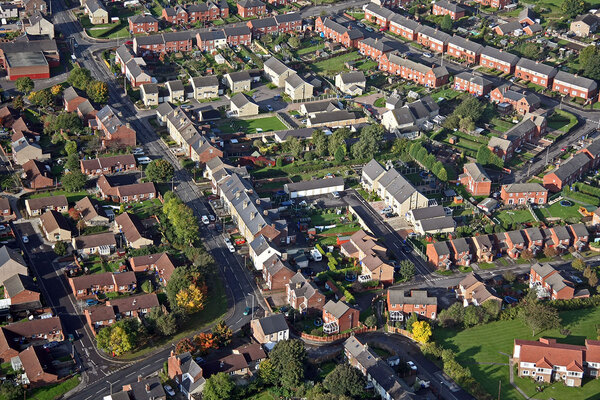
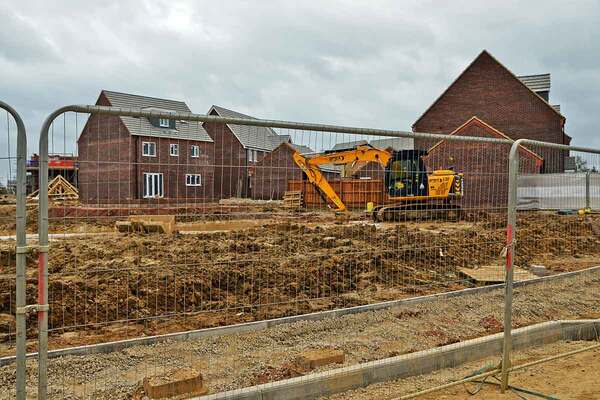

Ms Esimaje-Heath added: “I think in three to five years, a lot of associations will have income capacity. But if we want to continue, we want to see housing built in that time, someone’s going to have to hold it, someone’s going to have to help the housebuilding sector.”
L&Q declined to comment further on the idea.
Social Housing understands the Ministry of Housing, Communities and Local Government is aware of concerns about reduced appetite from registered providers of social housing to buy affordable homes delivered under Section 106 agreements. The department will continue to work with house builders, local authorities, and RPs to tackle this issue.
The proposal comes after Homes England launched a “clearing service” for Section 106 homes last December, allowing house builders to list unsold homes. More than 200 registered providers and councils also signed up to the service to view the unsold stock.
The issue of developers seeing a lack of demand for Section 106 has been growing as many housing associations face constrained finances and concerns have been raised over the build quality of homes.
Social Housing revealed last June that the National Housing Federation was in talks with house builder trade body the Home Builders Federation, as well as the government, about solutions to the drop in demand for Section 106s.
Early engagement on Section 106s
Speaking on the same panel, Jo Makinson, chief investment officer at Abri, said the housing association speaks to developers “very early on” in the Section 106 process to talk about “what we like and what we don’t and what’s worked before and what hasn’t”.
Minimum standards for affordable housing
The panel also discussed whether there is a case for a possible national minimum standard for affordable housing.
Ms Makinson pointed out that the standards would need to be “carefully” drafted.
“The standards would have to be really well thought through in terms of they have got to incentivise doing more rather than stop it happening,” she said. “And I think that’s going to have to be a carefully drafted set of standards, I guess, to make it work.”
Janany Kathirgamanathan, partner at law firm BCLP, said she believes that an “informed” standard backed by the sector could help, but said that no one wants it to be a barrier to delivery.
“I think as long as it’s an informed standard, and I think you need to get the backing of a lot of RPs in terms of actually buying into that standard to actually make it work so the market actually drives that forward as well,” she said.
“Then I think if it does help in terms of delivering affordable housing, that can only be a good thing, but you just don’t want it to be a barrier.”
Sign up for Social Housing’s weekly news bulletin

Picture: Alamy
Social Housing’s weekly news bulletin delivers the latest news and insight across finance and funding, regulation and governance, policy and strategy, straight to your inbox. Meanwhile, news alerts bring you the biggest stories as they land.
Already have an account? Click here to manage your newsletters.
RELATED

Insight30 Jan 2026
Market digest: housing association bond yields – January 2026

Insight30 Jan 2026
Special report: growth in shared ownership sales slows to five-year low



- © Social Housing
- All rights reserved