


‘We’re putting the park back into east London’: the LLDC’s new chief on ‘activating’ inclusive growth
The London Legacy Development Corporation is hoping to change the lives of east London residents through creating five new neighbourhoods around the Queen Elizabeth Olympic Park. Sarah Williams meets chief executive Shazia Hussain to find out more about the organisation’s plans. Photography by Belinda Lawley


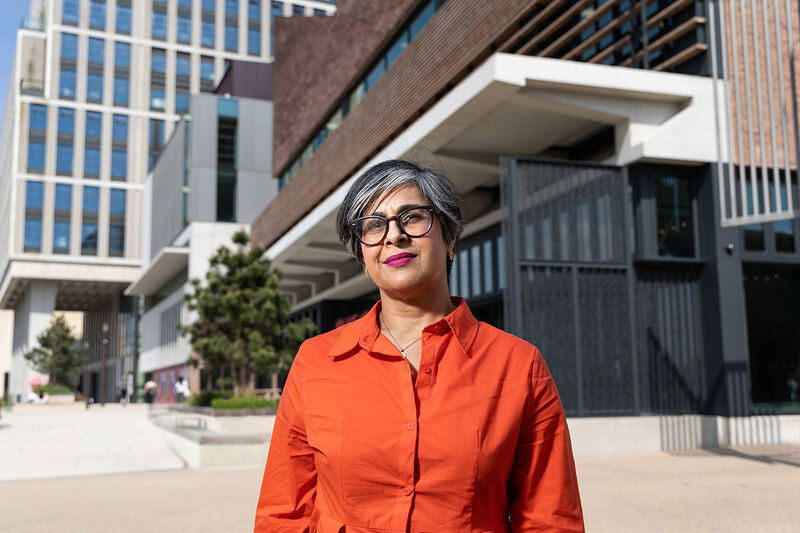
Shazia Hussain: “We are putting the Queen Elizabeth Olympic Park back into what I call the ‘informal sub-region’ of east London, and working really closely with the four boroughs”
Sharelines
‘We’re putting the park back into east London’: the LLDC’s new chief on ‘activating’ inclusive growth #UKhousing #SocialHousingFinanceShazia Hussain, chief executive of the London Legacy Development Corporation (LLDC), is standing on the external viewing deck of the UK’s tallest sculpture.
Designed by Sir Anish Kapoor and Cecil Balmond for the London 2012 games, the looping red steel structure knots together past and future, with panoramic views over a rapidly changing east London.
Ms Hussain is pointing out the five new neighbourhoods being developed as part of continuing works to deliver the physical legacy of the games, of which around “one and a half” have been built to date.
With a breeze blowing over the 80-metre-high platform, Social Housing’s recording device and mildly vertiginous editor feel a tad precariously placed.
But the LLDC’s new chief executive, who took up her role in November, is sure footed as she surveys the perimeters of a park constructed for that most global of events. In setting out her vision for the latest phase in its evolution, Ms Hussain is instead looking to the local.
“We are putting the Queen Elizabeth Olympic Park back into what I call the ‘informal sub-region’ of east London, and working really closely with the four boroughs,” she tells me.
Read more


‘Activation optimisation’
Thirteen years on from the Games, the park’s metamorphosis reached a new milestone this year as several major cultural and educational institutions opened their doors.
The park’s East Bank cultural centre includes new premises for BBC Studios, dance theatre Sadler’s Wells, museum the V&A East Storehouse and higher education institutions UCL and London College of Fashion, all now open. But for Ms Hussain, the completion of these venues is not an end in itself, but the beginning of a new challenge.
Recognised as one of just three ‘innovation districts’ in the 2025 Growth Plan, the park has a stated aim to be the “world’s most inclusive” such district. That means ensuring these institutions are capitalised on at a local level.
“We’ve done the build, and now it’s about making sure that we don’t just have a park that’s internationally recognised, that’s globally relevant,” Ms Hussain says. “We’ve got all these amazing anchor institutions – there is a risk that you could just have a park with lots of great assets on it. But how do you make them ‘work’?”
On this, Ms Hussain refers to park’s origins, and its mission. This (as set out on the LLDC’s website) is to use the opportunity of the 2012 Games and the creation of the park to “change the lives of people in east London and drive growth and investment in London and the UK, by developing an inspiring and innovative place where people want – and can afford – to live, work and visit”.
It is the first of these objectives that is most important for Ms Hussain – changing lives of east Londoners. Bringing the 2012 Olympic Games to the area was, she recalls, “a catalytical moment” for many of those working in local boroughs at the time, herself included. This first phase drove forward efforts to encourage the city to “pivot to east London and see all this opportunity”.
The second phase, covering the 10 to 15 years following the games themselves, has been about building out the park, repurposing the sporting venues within its parameters and developing new neighbourhoods.
“A lot of that was about having [the LLDC’s] planning powers and making sure that we were able to maximise the potential of the landholdings, working with the boroughs. And we’ve done that.”
It is with this in mind that the new chief executive dubs the third phase – with which her arrival at a reshaped LLDC coincides – as “activation-optimisation”. That is: making the park part and parcel of the localities within which it sits and working very closely with the four boroughs its parameters span: Hackney, Waltham Forest, Newham and Tower Hamlets. This phase is expected to extend into the 2030s.
“Most importantly, we’re talking about growth being inclusive, so really activating that, and optimising that, and using the assets that we have, but also the investment that we can continue to bring.”
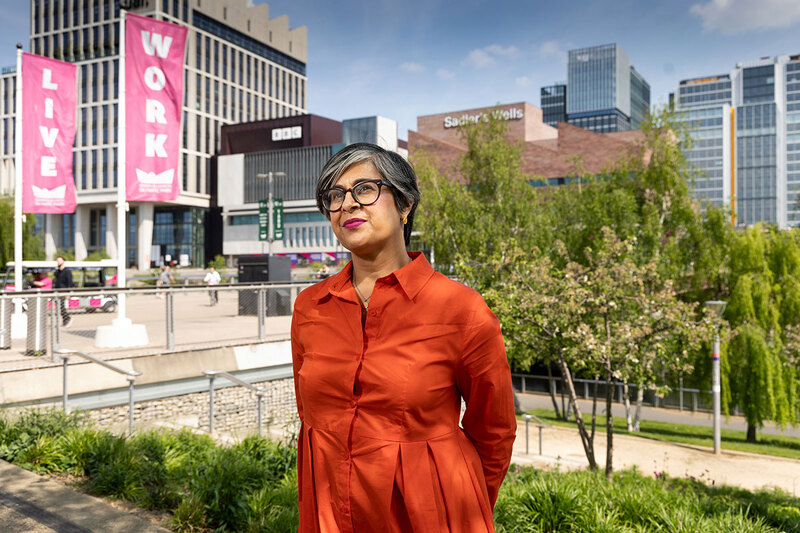
The park’s East Bank cultural centre includes new premises for BBC Studios, dance theatre Sadler’s Wells, museum the V&A East Storehouse and higher education institutions UCL and London College of Fashion
Of the four partner boroughs, Ms Hussain has previously worked directly for two: Waltham Forest and Tower Hamlets. Earlier in her career she also worked for a regeneration company within a third, Newham.
Ms Hussain’s most recent roles were as deputy chief executive of Waltham Forest for the two years prior to joining the LLDC and, before that, assistant chief executive at Brent Council.
These, and other career experiences, have shaped the LLDC chief executive’s awareness of the scale of the opportunity that Stratford’s East Bank cultural quarter brings. “Often when you’re trying to do inclusive growth and you’re trying to really think about ‘what does true regeneration mean for our communities’, you often don’t have the assets – you don’t have the universities [or] the big anchor institutions like the BBC or Sadler’s Wells.
“So for me, the opportunity that brings is to truly think about growth and to link it into the London mayor’s plan and what Sadiq Khan is saying about our future: repositioning ourselves as a global city, but also really thinking about how do we optimise on the growth and the investment?
“And, for me, how we make sure that’s relevant for London is the most important: how that’s relevant to east Londoners.”
This means thinking about skills and employment, including via the LLDC’s ‘good growth hub’, a cultural and digital sector recruitment service for young people, and its annual ‘East Careers Week’, which this year engaged with more than 1,500 students from secondary schools and further education institutions across the growth boroughs. In addition, the Build East Construction Training Centre at East Wick is focused on supporting local residents to develop retrofit and insulation skills.
Ms Hussain says: “[It’s about] not treating our community as if it’s a community of deficit, [because] actually it’s a community of optimisation and opportunity.”
She adds: “Our future marketing audiences, our future curators, our future creators are sitting among us. How do we make sure that this really engages with them and activates them?”
Relinquishing planning powers
The increased focus by the park’s leadership towards the boroughs around it coincides with some key powers passing in the same direction.
After being established as the first ever mayoral development corporation (MDC) in 2012, the LLDC had acted as local planning authority for new developments within its boundaries, with the power to approve or reject proposals, and to give guidance to developers. This was intended to enable it to deliver the physical legacy of the Games, as a single body with “responsibility for co-ordinating regeneration, development and planning within the area for which it had been established”, as legislation set out at the time.
In December, following a mayoral decision two years earlier, those planning powers were handed back to the four boroughs. The LLDC’s boundaries were at the same time reduced to primarily include the areas where the corporation owns, manages or operates land.
The LLDC’s governance structure and board were then reconstituted in April 2025, with a smaller headcount to reflect the new remit.
For Ms Hussain, the removal of planning powers is not a loss in itself, but representative of the requirements of the current phase. “People often talk about… the fact that the planning powers are handed over. But that [change is] OK, because that wasn’t the ‘all’ of what we did. That is a part of what we did and actually, for that period, we needed the planning powers to be able to work and make sure that we were building the types of developments and housing that we need to do.
“We’ve done that. We’ve done the master planning, and now what we need to do is work in a partnership way with our boroughs.”
The LLDC remains a mayoral development corporation, and as a part of the Greater London Authority (GLA), the LLDC’s relationship with the mayor continues to be “very close”, Ms Hussain says. “They continue to invest in us as a place, as well,” she adds.
Housing: a ‘central focus’
The LLDC’s focus on inclusive growth would be a hollow pledge without an accompanying focus on housing, and affordable homes at that.
While some earlier schemes reflect targets in line with previous mayoral policy of 35 per cent, the corporation is now targeting 50 per cent affordable across its remaining portfolio by the mid-2030s, by which time all its housing stock will have been completed. This is in line with the 2021 London Plan.
“Affordable housing is absolutely our central focus,” Ms Hussain says.
“We’re absolutely committed to that [50 per cent affordable target], and that is a very clear directive from the London mayor as well. This place is for living and for working and for visiting, and it needs to do all three. So we want to make sure that we have five neighbourhoods of communities who live here.”
Together, approximately 5,877 homes will be delivered on LLDC-owned land (of which around 1,392 have been delivered to date), and a total of 33,000 homes are expected across the wider legacy area in partnership with the boroughs. This figure was set out in the LLDC’s 2020-2036 Local Plan, and more than a third of these (13,000 homes, including purpose-built student accommodation and co-living) had been completed by December 2024 when the corporation’s planning powers were handed back to the boroughs. It will now be in the hands of the partner boroughs to progress the delivery of the remaining homes.
Homes and neighbourhoods
The five new neighbourhoods are namely Chobham Manor, East Wick, Sweetwater, Stratford Waterfront, and Pudding Mill (incorporating the two sites of Pudding Mill Lane and Bridgewater Triangle).
Of the five new neighbourhoods, “one and a half” communities have been built to date, with Chobham Manor complete along with the first phase of East Wick.
The LLDC also owns several smaller development sites including Rick Roberts Way, Hackney Wick Central, Aquatics Triangle and Bromley-by-Bow.
Homes in development on land owned by the LLDC include:
- A joint venture between Places for People and Balfour Beatty Investments at East Wick and Sweetwater, which will deliver a total of 1,859 homes at the completion of the final phase. These include affordable and private rented homes.
- 700 homes to be delivered at Stratford Waterfront, under a joint venture (JV) between the LLDC and Ballymore, with 35 per cent affordable housing on site.
- 190 homes, all affordable, being delivered by Notting Hill Genesis at Hackney Wick Central, which are due to complete next summer.
- Separate 50:50 joint ventures with developers Ballymore and Vistry Group on two sites near Pudding Mill Lane station, which will together deliver around 1,500 new homes (Bridgewater Triangle: c.575 homes; Pudding Mill Lane: c.950 homes). These will have a minimum of 45 per cent for affordable, including ‘family-sized’ homes.
- Rick Roberts Way, which is expected to deliver a minimum of 450 homes, with a development partner yet to be appointed.
Building the right homes in the right places is particularly vital for the Queen Elizabeth Olympic Park to fulfil its role as an innovation district, Ms Hussain says, with not only the “makers and creatives… but also the community living there”.
She adds: “The neighbourhoods become really important, and the type and quality of design that we’re putting into those homes. We’re making sure that the tenure is relevant to the local communities [and] that it’s as affordable as we can make it.”
At the same time, in line with the mayor of London’s stated target of reaching net zero by 2030, LLDC’s design standards target net-zero carbon emissions by 2030 for Scope 1 and 2 emissions, and by 2038 for Scope 3.
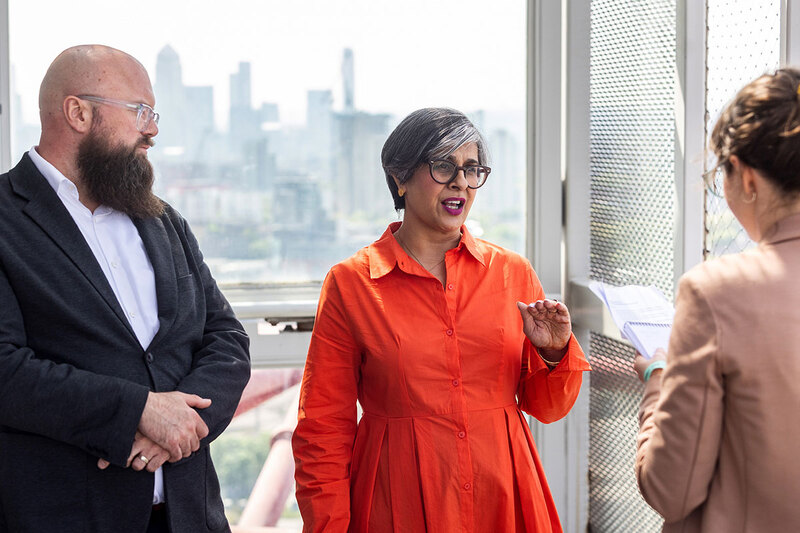
Left to right: Darren Parker, executive director of development at the LLDC; Shazia Hussain, chief executive; and Sarah Williams, editor of Social Housing, visit the ArcelorMittal Orbit sculpture
Housing to the fore
LLDC’s ambition in the housing arena is reflected in recent hires. Executive director of development Darren Parker – who joins Ms Hussain for our interview – arrived at the corporation in February from L&Q, where he was director of regeneration and development. And a year ago, in August 2024, the LLDC recruited Suki Kalirai, chair of PA Housing, to take up the same role on its board.
Speaking to Social Housing about the corporation’s housing efforts, Mr Parker emphasises that the removal of planning powers places the focus squarely on the development function. He says: “Planning permissions are in place, particularly the masterplans for our own sites, but it’s [about] driving now the delivery of that housing.”
This is being done in several ways, with the organisation “maturing” in its approach, he adds. “We have different types of partnerships, whether we’re just a landowner and we let a developer get on with it, or actually we’ve moved from that space of just being a landowner to actually being full joint venture partners for some of our latest sites that we’ve taken to market, so we’ll be sitting around the table with Vistry, with Ballymore, making decisions about those schemes, to sharing risk and reward.”
Within this, there remains potential for the LLDC to act as ‘convener’ on the land it owns. “We have land, for example, in Bromley-by-Bow, so we’re looking at bringing partners together and actually taking a master-planning approach. So we’re convening partners, not just to the local authority, but landowners and developers as well.”
At the same time, the corporation is exposed to the same operating weather other developers face, particularly those in London.
The company’s latest audited accounts note that the LLDC has needed to navigate a “testing housing and development market”, and refers to changes to fire safety statutory guidance causing “slippage” on some schemes.
Viability challenges caused by build cost inflation are also at play, along with the matter of “capacity within the RP sector for new business and purchasing homes”, Mr Parker adds. To address these issues, the LLDC looks to use its position as a landowner to support the continued delivery of key aims.
“We’re able to be creative about how we take that return [from the land], to make sure our partners are continuing to deliver the things that are important for us in London. So that is the sustainability design standards, it’s maintaining the target for affordable housing, and [we’re] maybe taking a view on the land value or our equity to return in the future.”
Asked whether the LLDC had itself faced issues finding partners to take on Section 106 homes in the current market, Mr Parker says he “expects” this could be the case with some of the new affordable housing packages it is taking to the market with its JV partners in the next six to 12 months.
“But,” he says, “given our role as a development corporation, we are interested in innovative partnerships around new affordable housing – so what can we be doing, both here and for the partners in London, to bring, for example, more patient capital into the sector?
“I think we’ve got an opportunity again [there], because we are an innovator.”
Lessons learned
At a time when the devolution agenda and the New Towns strategy mean that MDCs may be about to multiply, are there lessons to be learned from the LLDC’s experiences to date?
Ms Hussain sees several huge advantages to the model. She notes that international partners she has shared platforms with, including from North America, have expressed their envy: “Because actually, nothing else really exists like here.”
At the same time, she acknowledges that there are “lots of lessons learned, for sure”. The LLDC, together with the GLA, has been looking into how best to share these, not least for the benefit of its ‘sister’ MDC, the Old Oak and Park Royal Development Corporation, whose journey by contrast is just beginning. Knowledge-sharing to date has included the LLDC making representations to the House of Lords Built Environment Committee on how this might inform how new towns will be brought forward.
“What LLDC has shown is what you can do if you bring partners together and have a very clear vision about where you want to go,” Ms Hussain adds.
Thinking long-term is also crucial, Ms Hussain adds, referring by example to the decades-long efforts of stakeholders to pull off the coup of having a university like UCL located on the site.
“It’s about the ambition and the vision that you have to have, and you have to kind of hold your nerve. Then you have to be steady and know that sometimes those plans change, and how do you make sure that you’re flexible enough to be able to do that?
“You have to have government investment because without that, we couldn’t even have got started. But really, it is about making sure you’ve got that long-term vision.”
Sign up for Social Housing’s weekly news bulletin

Picture: Alamy
Social Housing’s weekly news bulletin delivers the latest news and insight across finance and funding, regulation and governance, policy and strategy, straight to your inbox. Meanwhile, news alerts bring you the biggest stories as they land.
Already have an account? Click here to manage your newsletters.



- © Social Housing
- All rights reserved