


Risk and resilience: Fiona MacGregor on regulating through 11 years of shocks and shake-ups
In her very last interview before stepping down as chief executive of the Regulator of Social Housing, Fiona MacGregor reflects on 11 years regulating through risk, navigating change and finding resilience at both a sector level and a personal level. Sarah Williams reports



After more than a decade as chief executive of the Regulator of Social Housing, Fiona MacGregor stepped down at the end of April (picture: Guzelian)
Sharelines
Risk and resilience: Fiona MacGregor on regulating through 11 years of shocks and shake-ups #UKhousingFiona MacGregor reflects on 11 years regulating through risk, navigating change and finding resilience at both a sector level and a personal level. Sarah Williams reports #UKhousing #SocialHousingFinanceThe smartwatch on Fiona MacGregor’s wrist is a giveaway for fellow runners. As she sits down for her very last interview while still in post at the Regulator of Social Housing (RSH), one question has effectively answered itself.
“I would love to have more time to do seriously more exercise, particularly more running,” Ms MacGregor says, when Social Housing asks how she will spend her time after stepping down as chief executive. “It’s kind of now or never.”
Ms MacGregor already has two half marathons lined up and intends to “do the training properly this time” after feeling somewhat unprepared at an event last year.
A quick glance at the agenda for the regulatory body since 2015 when Ms MacGregor became its boss makes it easy to understand why she may have been short on time – while needing plenty of drive to go the distance.
To name a few: navigating a shock announcement on rent cuts the same year, launching the RSH as a standalone body in 2018 and introducing a new proactive consumer regulation regime from April 2024 as part of the government’s response to the Grenfell Tower fire.
Read more



Added to these has been the importance of tending to the sector’s vital ‘no loss on default’ record, something Ms MacGregor says she is “relieved” to have maintained. Against a ceaseless flurry of macroeconomic storms that have impacted financial markets, development and more, and with total sector debt now exceeding £105.4bn, it has surely been no small task.
That said, Ms MacGregor still has two weeks to go when Social Housing sits down with her over a video call. “Please don’t let everything go horribly wrong,” she says.
During the interview, we delve into what leading the regulator’s response to these priorities looked like from the inside, which economic episode proved the most testing and her reflections on resilience at a sector – and personal – level.
Our conversation also digs into the political positioning of regulation today and the path ahead for her successor – announced just days after our interview to be long-time colleague Jonathan Walters.
On top of that, amid growing calls for ‘new models’ of investment, Ms MacGregor tells Social Housing why she feels the RSH has been “badly misrepresented” on its appetite for innovation.
Always housing
Ms MacGregor’s arrival in housing came about by chance, when she found a role as a typist at a housing association in Edinburgh amid the recession-hit job market of the late 1980s. Back then, she says she “didn’t even know what regulation was” – but the sector would soon cast its spell.
“I knew that housing was where I loved it, right from the start,” she says.
In 1989, she moved to England and began work as an admin assistant at the Housing Corporation, which would later become the Housing and Communities Agency (HCA) and subsequently the RSH.
That she would one day find herself the regulator’s chief executive was “completely an accident”, Ms MacGregor says.
After a few years at the Housing Corporation, she went to work in development at housing association L&Q for 10 years – up until 2002. She describes the decade spent there as “brilliant” and the experience gained on the landlord side of the sector as “utterly formative” to how she approached her regulatory career.
“Regulation doesn’t get in the way of growth or shouldn’t – you have to apply it sensibly”
First, as L&Q’s head of development and supported by its financial leaders at the time, Ms MacGregor honed a strong focus on risk.
“Risk was everything, so you needed to understand the drivers; you needed to understand the impact,” she says. “And it wasn’t just theoretical. It was, you know, could you quantify it? What could you do to ameliorate it? So, a really deep understanding of risk management and seeing things through a development lens – it was very direct.”
Second, Ms MacGregor’s work on the tenant-facing element of regeneration and stock transfers, during ballots and consultations, showed her both the “positive impact on people’s lives of improving the quality of their homes” and the importance of listening.
“I loved working with the tenants. And they would tell you really sensible things about, ‘That design will never work,’ you know, ‘You need to think about this instead.’ And they were almost invariably right.”
A return to the Housing Corporation in 2002 to work on its London investment programmes as a deputy director came about because of “pull rather than push factors”, Ms MacGregor says. “[It] was the only job I would have left L&Q to do.”
Around four years later, she moved to work on the corporation’s national programmes. Then, as now, she was struck by “how different it is working in London and working anywhere else”.
By 2015, Ms MacGregor was working as executive director of programmes at the organisation she had first joined as an admin assistant, by then known as the HCA.
What happened next she wryly blames on her colleague (and, as is now known, her successor) – Mr Walters. “It’s completely his fault. He made me do it, and I mean literally made me do it.”
The HCA was looking for an executive director of regulation at a time that senior staff were going to have their hands full implementing the recent shock announcement on the rent cuts.
After putting herself forward, Ms MacGregor became executive director of regulation in an interim capacity, which soon became permanent. As to how she felt at this point, Ms MacGregor answers simply: “Terrified.”
Chief executive
Coming just two years after housing association Cosmopolitan had been rescued from the brink of insolvency, the rent policy reversal stoked lingering fears around lenders’ confidence in the sector.
“We worried a lot about, ‘Does that count as a major adverse event? Does that trigger defaults?’” Ms MacGregor recalls. “Everybody was [thinking], ‘Can we get through this next storm?’”
The following year, another major ask landed on her desk, as the government’s ‘tailored review’ of the HCA would conclude that the organisation’s regulatory function needed to be split out from the national delivery function (what is now Homes England).
“This sort of dawning realisation that this [Grenfell] wasn’t a one-off, unique incident; it could happen elsewhere. And that leads to the change”
These recommendations would lead to the launch of the Regulator of Social Housing as a standalone body in October 2018. Getting there was a task that Ms MacGregor would have been “scared” to take on had she known about it in 2015. “I’d have thought twice,” she says.
However, in the event, it was a welcome challenge.
“I was surprised how much I enjoyed us becoming a standalone organisation. And having been pretty successful, I’m really proud of that actually,” she says – before, as she often does in our interview, redirecting the credit for the achievement to her team.
But there was another, bigger change to come: the introduction of the new proactive consumer regulatory regime. This formed part of the government’s response to the Grenfell Tower fire in 2017, in which 72 people lost their lives.
Grenfell
As Ms MacGregor told a recent sector event: “Grenfell changed everything.”
What did that look like at the regulator in the days and weeks following the fire, Social Housing asks.
Ms MacGregor remembers going into the RSH’s Marsham Street office, shared with what is now the Ministry of Housing, Communities and Local Government, and being struck by a “hush, which lasted for weeks”.
“To begin with, it was always, ‘How could this have happened? How could it have had such an impact?’’
“And then this sort of dawning realisation that this wasn’t a one-off, unique incident; it could happen elsewhere. And that leads to the change.
“And the biggest single change, quite rightly, is that focus on building safety across all tenures.”

Fiona MacGregor speaking at the Social Housing Leaders Conference 2025
She praises the work of Grenfell United and other survivor groups. “They’re angry, rightly angry, but not just anger being an end in itself but [saying], ‘How do we fix this and make sure it doesn’t happen again?’ They’ve been incredible.”
A new Building Safety Regulator was introduced in 2021, while the RSH’s remit to introduce a new “proactive” consumer regime was confirmed in the government’s Social Housing White Paper, published in November 2020.
This marked a key change from the RSH’s previous mandate to intervene only when there was a risk of ‘serious detriment’ to tenants.
More broadly, introducing the new consumer standards and the accompanying regime has “rebalanced something that really needed to be rebalanced”, Ms MacGregor states.
“What it’s done, and you can see this playing out across the sector, is that utterly salutary reminder that you must listen to your tenants and engage with them.”
Two years into the new regime, Ms MacGregor is “really pleased” with how it has gone, but again emphasises this is “because of the team”. She cites the interaction with local authorities, which now form part of the consumer regime, and tenants.
Regulation, reputation
The past few years may have seen the volume on consumer regulation dialled up, but it is only a decade-and-a-half since it was dialled down, when the Tenant Services Authority was scrapped. And while new regulations are still being ushered in under the current government, there are plenty of people in the sector who feel that regulation is a barrier to progress.
Social Housing asks for Ms MacGregor’s sense of the way regulation is regarded both in the sector and in Westminster. Is she optimistic that the case for co-regulation has been won?
The short answer, she says, is “yes”. “But you’re only as good as your last test.”
“You can go through periods that are articulated in different ways, from ‘ripping up red tape’ to regulation not getting in the way of growth and what have you,” she says. “Regulation doesn’t get in the way of growth or shouldn’t – you have to apply it sensibly.
“But as soon as something goes wrong, there’s a [question of], ‘Where was the regulator?’”
Therefore, the goal – and what she would advise her successor to strive for – is to avoid what she calls “mad, performative zigzagging all over the place”.
“Regardless of external circumstances, you’re trying to walk that kind of middle ground between preventing harms, but not stymieing innovation and progress,” she adds.
‘Calm approach’
Directors of organisations working at the coalface of governance praise Ms MacGregor’s pragmatic approach to regulation.
Dr Fiona Underwood, executive chair at consultancy Altair, notes that her “calm approach during very challenging and turbulent times has benefitted the sector and this will rightly be her legacy”.
Greg Campbell, a partner at Campbell Tickell, adds that an “ability to steer the regulator successfully through a huge and continuing variety of challenges, including a substantial reshaping and extending of the regulatory regime, has been hugely impressive, and consistently so”.
Kelsey Walker, director at Savills’ Affordable Housing Consultancy, points to what she calls the “underrated skill” in leading the regulator of “being able to reconcile the many different pulls from government, the sector, funders, tenants, colleagues and other stakeholders”.
She adds: “Fiona does this with great pragmatism and a focus on doing the right thing – not always the easy thing.”
Innovation?
This neatly leads us on to the call for innovation, including new financial models (which in the days that follow our interview will heat up even further).
Social Housing asks whether the regulator’s plans to refresh its economic standards will lead to changes in its approach to its mandate to encourage investment into the sector. For example, a warmer reception to equity capital models, or perhaps a swifter registration process for for-profit providers?
Ms MacGregor feels “quite strongly” about this topic. “I think we’re really badly misrepresented on what we say about this,” she says. “We’re not saying equity’s bad. What we're saying is: manage your risk.”
She adds: “If you’re talking about equity, then we want to understand – and the organisation itself should want to understand – what does that mean about who’s in control? It’s very different to lending or borrowing.”
No loss on default
In a similar vein, the RSH is at pains to be clear in its language where that all-important ‘no loss on default’ record is concerned.
Ms MacGregor points out that, when talking about it in any sort of detail today, the regulator will add the line “on borrowing secured on social housing assets”.
“Because there’s a real moral hazard here,” she explains. “We’re not saying nobody will ever lose any money ever on social housing, if [they] do stupid things.
“But, for ‘secured on social housing’ – the model that we’re familiar with – it’s really important.”
Most ‘financially acute’ period
The record has been upheld through some testing times so far. Reading the last few Sector Risk Profile publications, it would be easy to conclude that every passing year had been the “worst” to date from a financial standpoint, Social Housing suggests, whether from building safety spend or the market volatility of recent years.
What, then, has been the most perilous period from Ms MacGregor’s perspective?
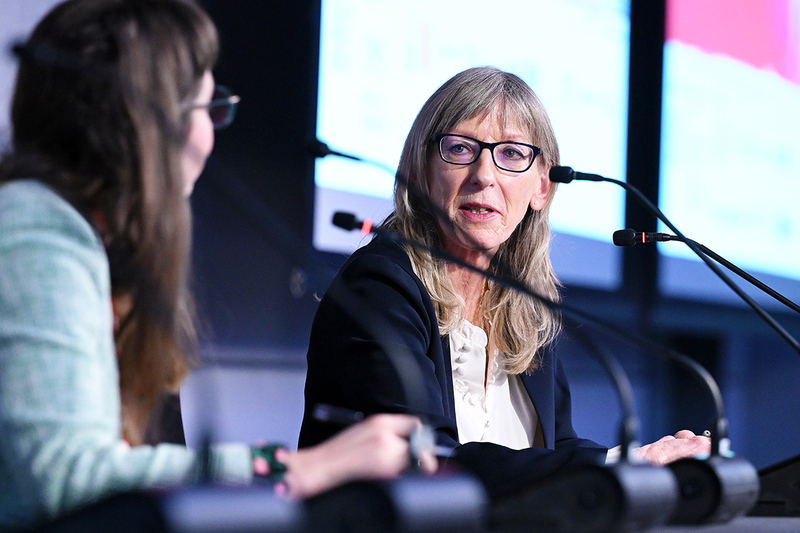
Fiona MacGregor on a panel with Social Housing editor Sarah Williams during the Social Housing Leaders Conference 2025
Pointing to an event pre-dating her time as RSH chief, she names the 2008 financial crash as the most “financially acute” for the sector.
“There had to be bail-outs, and [there were issues around] embedded swaps and mark-to-market risk and all the rest of it, which was a big wake-up call.”
However, in the years that have followed, the sector has “matured hugely” in its approach to risk, she says, with the regulator’s insistence on stress-testing playing its part.
As a result, it has been “more resilient” than anyone might have expected beforehand.
“Everybody’s more resilient than they think,” she says.
Personal resilience
This same sentiment can be applied to our interviewee herself, after what have been an incredibly challenging four years or more personally.
Ms MacGregor’s husband Peter Betts, a respected climate diplomat, passed away in October 2023 after nearly two years of serious illness.
“It teaches you huge amounts about what’s important,” she says. “But you also see very quickly just how good people are in supporting you – just unbelievable care and support and love that we had, from all over the world actually.”
Alongside this much-needed support, Ms MacGregor reflects that staying in her post – after reversing previous plans that would have seen her step down in 2023 – helped her to keep going.
“I don’t think I could have not had work to come back to when Pete died,” she says.
Another task needed her attention, too: seeing through to publication the book her husband had set out to write before his death. In collaboration with his editor, this was published last autumn and provides a personal history of the Conference of the Parties.
“If life tells you anything, it’s don’t take it for granted that you’re going to always have that bit more you can just keep deferring”
Partway through one of the speeches at the launch event, Ms MacGregor finally felt herself relax. “We’ve done it,” she recalls feeling.
Now she acknowledges that she needs time to recover, making it the right time to step down from the RSH.
“You’re always thinking, ‘If only I had a bit more time, I would do X.’ And if life tells you anything, it’s don’t take it for granted that you’re going to always have that bit more you can just keep deferring.”
In the immediate term, this means putting her running shoes back on.
But Ms MacGregor is also keen to stay active professionally. “I hope I’ll do a few things that are housing-related,” she says, quipping that she is not quite ready to start “plumping cushions” at home.
But while avoiding the beige in her next step, her advice to her successor takes a different tone. Here she advocates that hallowed middle ground of regulation. In summary: “Stay calm. Be boring.”
Other recent interviews by Social Housing
SNG’s Peter Benz: our fundraising activities are ‘wide in nature’
SNG’s chief financial officer talks to Social Housing about the strategy behind securing more than £2bn in the two-and-a-half years since its merger, and the plans ahead for the 85,000-home landlord. Michael Lloyd reports
SettleParadigm’s CFO on how the landlord plans to expand post-merger
Less than two months since SettleParadigm was formed via a merger, chief financial officer Nicola Ewen is eyeing the benefits of scale as the group seeks to become “larger and more local”. Michael Lloyd reports
Sir James Cleverly: ‘fundamental change’ required to tear down development barriers
The shadow housing secretary is ready to “listen and learn” as he familiarises himself with a still-new brief, but is certain of one thing: getting homes built will require a “fundamental step change”. Sir James Cleverly talks Keith Cooper through his take on housing’s challenges
Sign up for Social Housing’s weekly news bulletin
Social Housing’s weekly news bulletin delivers the latest news and insight across finance and funding, regulation and governance, policy, and strategy, straight to your inbox. Meanwhile, news alerts bring you the biggest stories as they land.
Already have an account? Click here to manage your newsletters.
RELATED

News05 May 2026
Appointments round-up: April 2026

News01 May 2026
Two G15 landlords receive first consumer grades


News29 Apr 2026
Two councils receive consumer upgrades


- © Social Housing
- All rights reserved